Call for Papers
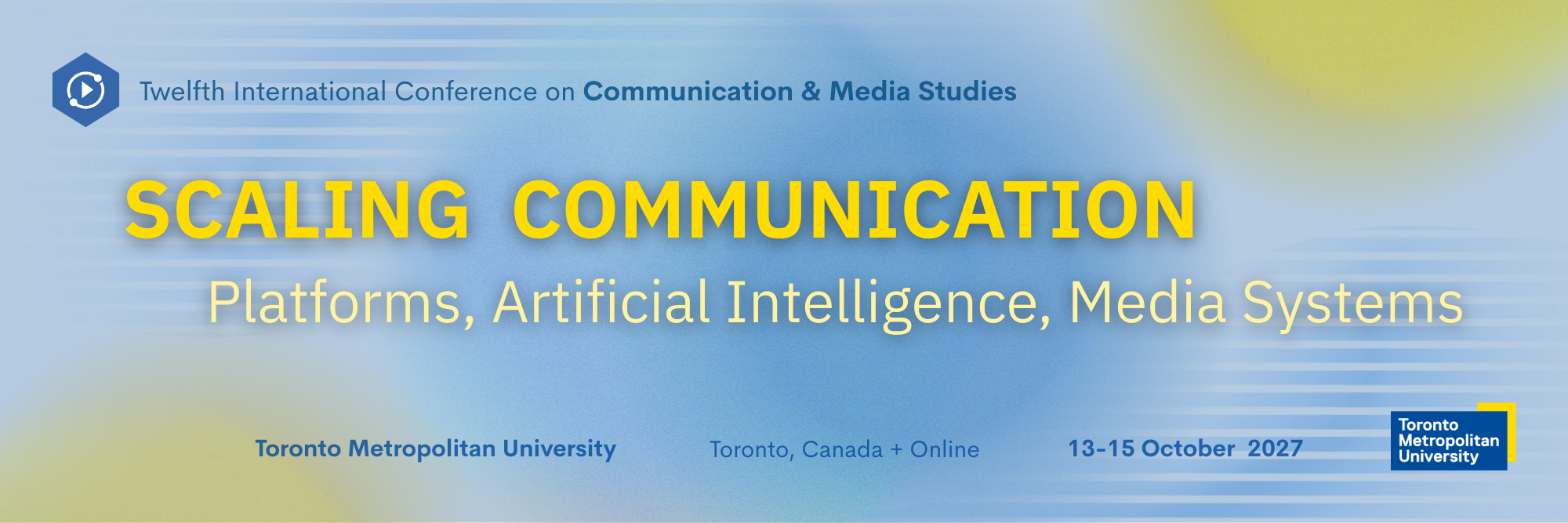
We invite you to join us for the Twelfth International Conference on Communication & Media Studies, the annual meeting of the Communication & Media Studies Research Network, hosted by Toronto Metropolitan University, taking place in Toronto and online. This year, the conference is held alongside the annual meeting of The Image Research Network, reflecting shared interests in visual communication, media cultures, and the forces shaping contemporary image ecologies.
The Twelfth International Conference on Communication & Media Studies brings together scholars, educators, researchers, creators, and practitioners concerned with communication in its social, cultural, political, and technological dimensions. We welcome proposals that examine how emerging production systems and communication technologies—platform infrastructures, AI-assisted workflows, and live/remote modes of production—are transforming the conditions of public life, cultural expression, and institutional practice.
Special Focus and Themes
The 2027 Special Focus, Scaling Communication: Platforms, Artificial Intelligence and Media Systems, invites participants to investigate how contemporary media is increasingly produced through connected, cloud-based, and platform-dependent infrastructures. At the same time, as AI is entering editorial and creative workflows, distribution is shaped by algorithmic ranking and metrics; moderation and safety are increasingly automated; and live, remote, and hybrid production models have normalized real-time collaboration across distance.
These shifts bring new efficiencies and forms of participation, but they also intensify questions of governance, transparency, labor, inequality, and credibility. How does scalability reshape editorial judgment and professional expertise? What kinds of publics are formed through platform infrastructures? How do institutions—news organizations, cultural industries, universities, governments, and civil society—adapt their responsibilities in an environment of accelerated production and automated circulation?
We encourage proposals that connect technical and organizational change to wider consequences: the distribution of voice and visibility, the extraction of value and data, the transformation of professional work, and the fragility of trust in contested information environments. Submissions may be empirical, theoretical, historical, methodological, design-oriented, or practice-based, and may address communication and media across local, national, and global contexts.
Sub-themes
- AI and Automated Production Workflows: Generative tools, automation in editing and publishing, newsroom/creative pipelines, quality control, authorship, and governance.
- Platforms, Infrastructure, and Scalability: Cloud production, distribution architectures, interoperability, metrics and monetization, content moderation systems, and platform power.
- Live, Remote, and Hybrid Media Production: Distributed crews, virtual studios, real-time collaboration, latency and reliability, event media, and new hybrid audience formats.
- Labor, Institutions, and Public Trust: Shifting professional roles, skills and education, precarity and union responses, policy/regulation, legitimacy, and misinformation/provenance.
Format
The conference is organised as a hybrid knowledge experience, integrating in-person and online participation within a unified scholarly environment. All accepted proposals become Presentation Pages, where presenters upload abstracts, media, and reflections, and where delegates engage in discussion before, during, and after the event.
In-person sessions in Toronto are interwoven with live online presentations and asynchronous contributions within a single integrated program. Regardless of participation mode, all delegates have access to the full schedule, session media, and a growing digital archive. Across formats, the emphasis is on reciprocal, human-scale exchange—conversation, reflection, and collaborative inquiry rather than one-way presentation.
Publication Pathways
Presenters are invited to develop their conference contributions for possible publication in The International Journal of Communication and Media Studies. The journal provides a pathway for participants to extend work first shared at the conference into a fully developed scholarly article. The journal is Hybrid Open Access, supporting both broad dissemination and rigorous peer-reviewed publication.
Presenters may also propose longer-form works for the Communication and Media Studies Book Imprint, which publishes monographs and edited collections advancing research and practice in the fields of communication, media, and public culture.
Membership and Community
We welcome new and returning members to the Communication & Media Studies Research Network. By purchasing a Presenter Pass, you automatically become—or renew as—a Network Member for the year, with access to year-round publications and community resources that support ongoing collaboration and scholarly exchange.
Membership sustains the Research Network, ensuring continued access to programs, archives, journals, and books, and keeping ideas in motion over time—where belonging is defined by contribution and care.
Join Us
We warmly invite you to submit a proposal and join us—either in Toronto or online—for the Twelfth International Conference on Communication & Media Studies. Held in partnership with The Image Research Network, this year’s conference creates a space for critical and creative engagement with the infrastructures, systems, and practices that are reshaping communication today.
Together, we will explore how platforms, artificial intelligence, media systems, and evolving production environments are transforming public culture, professional practice, institutional responsibility, and the conditions under which communication scales across contemporary life.
Sincerely,
Stephen Sheps, Conference Chair, RTA School of Media (Sport Media), The Creative School, TMU, Canada
Joe Recupero, Conference Chair, RTA School of Media (Sport Media), The Creative School, TMU, Canada
AJ Cordeiro, Conference Chair, RTA School of Media (Media Production), The Creative School, TMU, Canada
Eric Freedman, Research Network Chair, Maryland Institute College of Art, United States of America
Jesús Miguel Flores Vivar, Research Network Chair (ES), Universidad Complutense de Madrid, Madrid, España
Phillip Kalantzis-Cope, Chief Social Scientist, Common Ground Research Networks, United States of America